Welcome!
Some people learn about the world from the Discovery Channel. Others explore it. Be an explorer!
Thursday, March 15, 2012
Crazy Mathematicians!
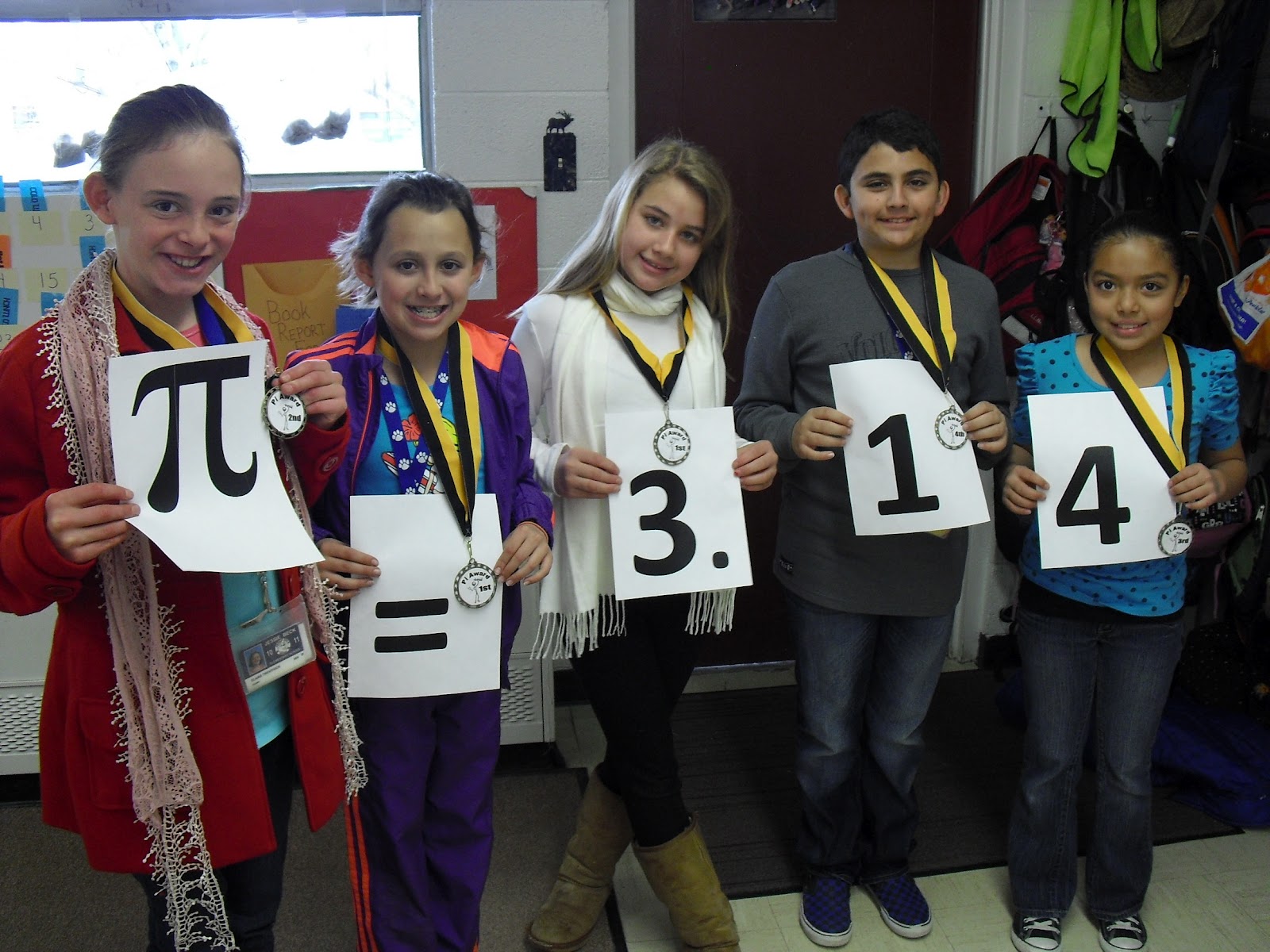
What mathematicians! In the classroom challenge, five students soared in memorizing the first several (actually more) digits of pi. In one night, these students memorized more than twenty digits of the irrational number. Fourth place memorized 24 digits. Third place memorized 30 digits. Second place memorized 34 digits, while two students tied for first place memorizing and astonishing 105 digits in the correct order! Simply AMAZING!
Wednesday, March 14, 2012
Pi Day TWENTY TWELVE
March 14, 2012
(3.14.12)
Today 5th graders learned about pi through the process of reverse engineering. They measured the circumference of many pies (thanks to everyone who sent one in) and then each pie's diameter. Using this data, they divided the circumference of the pie by its diameter to realize that the circumference of a circle is a little over three times its diameter. After calculating averages of their pi data, students saw how close they got to 3.14. We then had some dessert of pies for lunch, while listining to a Pi song.
Later in the afternoon, students in several intervention groups read about the history of pi and how past mathematicians made errors in their work, although their calculations were quite close. Working on high-level reading skills while focusing on a hot topic of the day kept kids engaged.
In math intervention, students applied their new knowledge of pi and calculated the circumference and area of circles using pi in formulas. Following this, they became engaged into a challenge of memorizing as many places of pi as they can in one day (for fun, not a grade) by watching a music video off a spoof of Lose Yourself.
The goal of today for me was to excite the children about pi, but also put an event and activity with the meaning of pi for future math lessons in later grades (I had many 6th graders come by and wish me Happy Pi Day today).
So......Happy Pi Day!
(3.14.12)
Today 5th graders learned about pi through the process of reverse engineering. They measured the circumference of many pies (thanks to everyone who sent one in) and then each pie's diameter. Using this data, they divided the circumference of the pie by its diameter to realize that the circumference of a circle is a little over three times its diameter. After calculating averages of their pi data, students saw how close they got to 3.14. We then had some dessert of pies for lunch, while listining to a Pi song.
Later in the afternoon, students in several intervention groups read about the history of pi and how past mathematicians made errors in their work, although their calculations were quite close. Working on high-level reading skills while focusing on a hot topic of the day kept kids engaged.
In math intervention, students applied their new knowledge of pi and calculated the circumference and area of circles using pi in formulas. Following this, they became engaged into a challenge of memorizing as many places of pi as they can in one day (for fun, not a grade) by watching a music video off a spoof of Lose Yourself.
The goal of today for me was to excite the children about pi, but also put an event and activity with the meaning of pi for future math lessons in later grades (I had many 6th graders come by and wish me Happy Pi Day today).
So......Happy Pi Day!
Thursday, March 8, 2012
Reproduction Parts of Plants
Today was quite exciting in plants, and perhaps the students will never look at a flower again in the same way. We dissected flowers and discovered what all the parts inside are called and their function. From pistils to stamens, from anthers to stigmas, and from pollen (what is really is) to seeds...the class now has a broad understanding of how plants reproduce.
Friday, February 24, 2012
Reading and Math
For the past few weeks we have been working on how to do research. Children have been learning how to take notes from biography books and from the internet, including how to properly make citations, parphrase, and hwo to write a bibliography page for where they obtained their information. Next week they expand this to using an encyclopedia. Eventually, in two weeks, students will use all of their notecards from all three sources to write a mini report on the American hero they chose to research.
In math, students have been working with negative numbers. This week was especially challenging, as they learned how to add AND subtract positive and negative numbers (example: 5-(-2)=). Knowing this is one of the most challenging concepts to wrap a 5th grade brain around, Miss. Fanning taught several strategies to help the class solve such problems, including walking on a number line, "add the opposite", and using special counters.
Wednesday, February 22, 2012
The Court House Fieldtrip
Written by RJ-
On Feb.9th we went to the Court House and we learned about many things, including having a mock trial. Plus, the Bailiff let us see pictures of people who smoked meth. They looked different from what they looked before. So don’t take meth! We also talked about peer pressure and what pressure can do to you. Two jail mates came in and told us what peer pressure did to them and their family.
Friday, February 17, 2012
Wasted Water Experiment
Written by a student in our class-
About a couple of weeks ago our teacher, Dr. Brock, was wondering how many gallons of water is wasted a year from the sink. Dr. Brock and our class decided that we should do an experiment to see how much water is wasted in the school from dripping faucets. Some faucets ended up streaming and we had to use a measuring cup instead of counting drops for our calculations. We did the experiment during lunch recess and 2:00 recess. It was really interesting. After we did the experiment, Dr. Brock went online and pulled up a water counting calculator, which did the calculations for us.
We put in the averages for the data we collected in each class. The result for how many gallons are wasted in a year in Dr. Brock’s class is around 3,673 gallons. That’s a lot! We also figured out that in the entire school we waste over 63,000 gallons of water a year. At least there is a good thing…next year the school will be revitalized and we will have new faucets and won’t be wasting a lot of water.
Written by Anthony
Subscribe to:
Posts (Atom)